Hyperglobalization 2.0: Why AI Has Not Slowed the World Down

Trade wars suggest deglobalisation, but the AI race is wiring the world together at unprecedented speed.
https://www.socialeurope.eu/hyperglobalization-2-0-why-ai-has-not-slowed-the-world-down
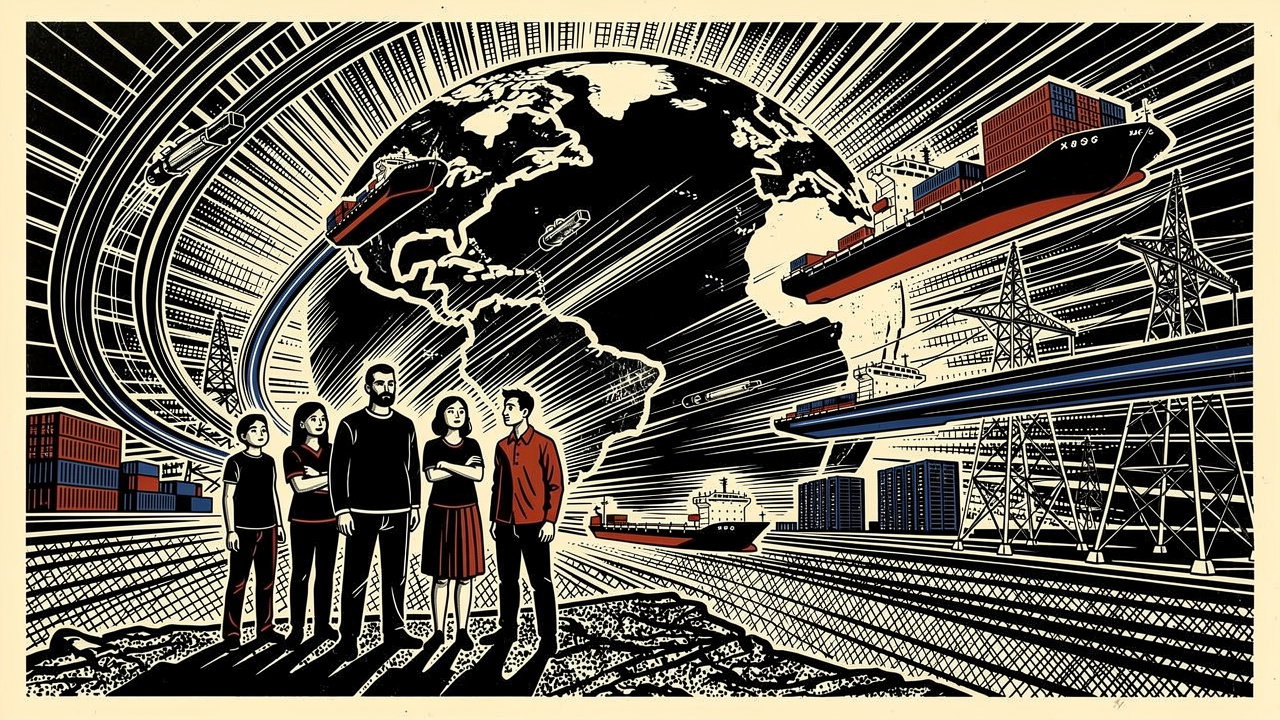
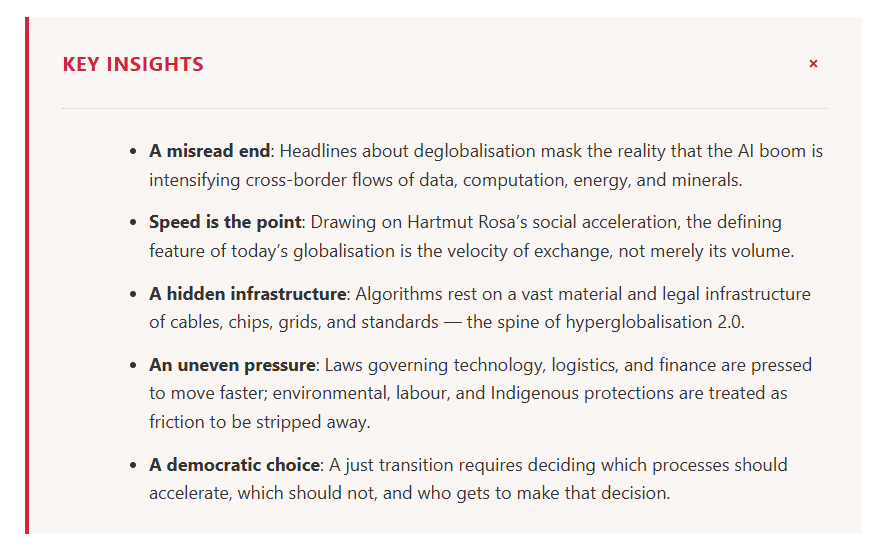
We are often told that the age of hyperglobalisation is over. Trade wars, industrial policy, national-security restrictions, export controls, and geopolitical rivalry all seem to point towards a more fragmented global economy. Governments are no longer speaking only the language of openness and integration. They are speaking the language of resilience, security, strategic autonomy, and supply-chain control.
But the artificial-intelligence (AI) boom tells a different story. Globalisation may be changing shape, yet it is not necessarily slowing down. Data, computation, telecommunications, energy demand, infrastructure development, and mineral extraction are all being pushed to move faster than ever. The world economy may be fragmenting in some respects, but in others connectivity is accelerating.
Hartmut Rosa’s work on social acceleration helps explain why this matters. Rosa argues that the distinctive feature of present-day globalisation is not merely the cross-border exchange of goods, capital, or information. It is the speed at which these exchanges occur. What matters is not only that capital moves, goods circulate, and information travels. It is that they do so with ever-increasing velocity, reorganising institutions, expectations, and social life around the imperative of speed.
AI is the clearest contemporary example of this phenomenon. It is often described as a frictionless race for data, talent, and computing power. Firms compete to train models faster, deploy systems faster, scale infrastructure faster, and capture markets before their rivals do. Governments, in turn, are urged to regulate faster, permit faster, invest faster, and adapt faster. In one way or another, these changes all point towards deeper and faster global connectivity.
snip
