Welcome to DU!
The truly grassroots left-of-center political community where regular people, not algorithms, drive the discussions and set the standards.
Join the community:
Create a free account
Support DU (and get rid of ads!):
Become a Star Member
Latest Breaking News
Editorials & Other Articles
General Discussion
The DU Lounge
All Forums
Issue Forums
Culture Forums
Alliance Forums
Region Forums
Support Forums
Help & Search
General Discussion
Related: Editorials & Other Articles, Issue Forums, Alliance Forums, Region Forums
EU Inc Is a Deregulation Tool in Disguise

The Commission’s optional “EU company” lets firms register anywhere and sidestep the national rules that protect workers.
https://www.socialeurope.eu/eu-inc-is-a-deregulation-tool-in-disguise
On 18 March 2026, the European Commission tabled a proposal that could carry far-reaching consequences for Europe’s industrial future — yet it has passed surprisingly under the radar. At first glance, the idea appears compelling: a “28th regime”, an optional European company framework that would let businesses operate across every member state under a single set of rules. The promise is attractive — create a company in 48 hours, for less than €100, entirely online. A dream for start-ups. A boost for competitiveness. A way to keep innovation in Europe. industriAll Europe does not oppose innovation. On the contrary, European industry is transforming at an unprecedented pace. New companies are emerging across sectors — from clean tech to batteries, from advanced manufacturing to mobility. Europe is rich in ideas, talent, and ambition. But innovation does not fail because registering a company takes too long.
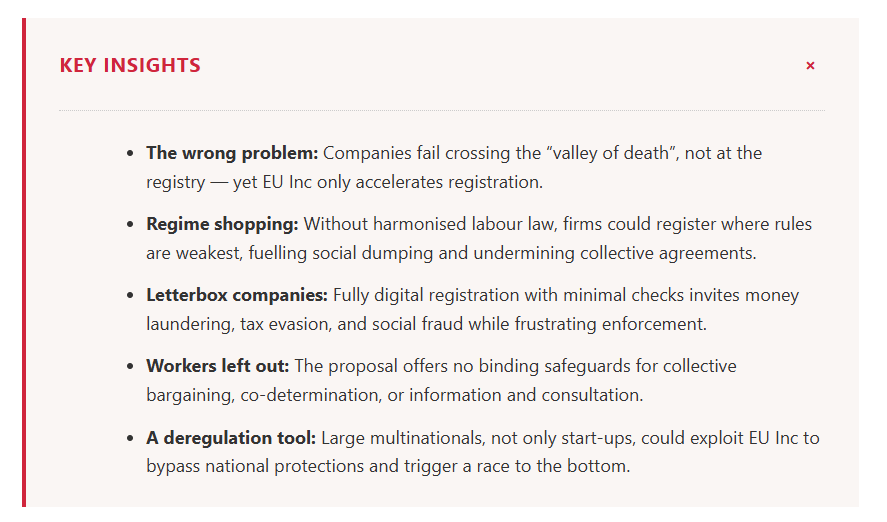
The problem is not how fast you can register a company, but whether that company can survive the “valley of death” — the critical phase between innovation and industrial scale-up, where too many European start-ups falter. The hard part is navigating the industrialisation and commercialisation phases, and crossing that valley remains an immense challenge — particularly in capital-intensive sectors such as batteries, where Europe is already struggling to scale up. What these companies need is not a new corporate label but access to finance adapted to industrial scale-up, support for infrastructure investment, tools to secure cash flow and manage risk in the early phases of production, and access to a skilled and qualified workforce. Recent initiatives point to where the real bottlenecks lie. New financial instruments are being developed to ease the burden of factory rental guarantees or to pre-finance production contracts — precisely because start-ups struggle with liquidity during industrial ramp-up. These are the kinds of measures that make a difference. The EU Inc proposal, however, does none of this.

Behind the narrative of simplification lies a deeper and more worrying reality. For industriAll Europe and the wider trade union movement, EU Inc is not merely a technical reform: it raises serious risks for workers’ rights, democracy at work, and fair competition. The first danger is social and regulatory “regime shopping”. EU Inc would let companies choose where they are registered without harmonising labour law, opening the door to selecting the weakest rules, fuelling social dumping, and undermining collective agreements. This is not a theoretical concern. Employers are already making their intentions clear: Italy’s Confindustria has argued that EU Inc should minimise reliance on national law — a clear signal that the aim is to bypass domestic rules wherever possible. In practice, this turns EU Inc into an instrument of competition between legal systems, with workers’ rights at stake.
A second danger lies in letterbox companies and enforcement gaps. With fully digital registration and minimal checks, a company can exist on paper in one country while operating in another, creating serious enforcement challenges for labour inspectorates, trade unions, and workers, and making it harder to ensure that the rules are respected in practice. There is also a critical risk of financial abuse: the combination of ultra-fast company creation, minimal capital requirements, and weaker checks opens the door to money laundering, tax evasion, and social fraud. Without strong safeguards on transparency and supervision, EU Inc could facilitate avoidance rather than innovation. The proposal is equally striking for what it leaves out. There are no binding safeguards for collective bargaining, trade union rights, or information and consultation. More concerning still, participation rights risk being tied to the country of registration, allowing companies to bypass stronger systems such as co-determination. This undermines a core principle of the European social model: that workers’ rights should follow the place where work is performed. In practice, it creates uncertainty for workers, weakens collective representation, and hands companies new avenues to circumvent established rights.
snip