Democracy, Control, or Competitiveness: The AI Trilemma

A new papal encyclical exposes the democratic trilemma shaping how the world governs artificial intelligence.
https://www.socialeurope.eu/democracy-control-or-competitiveness-the-ai-trilemma

Pope Leo XIV’s encyclical
Magnifica Humanitas, published in May 2026, is an unlikely document to set beside the CHIPS Act, the EU AI Act, or the most recent filings of frontier artificial intelligence companies. Yet anyone working on the political economy of technology should read it carefully. Not because it offers a regulatory blueprint — it does not — but because it poses, with unusual clarity, a question most policy debates still prefer to avoid: who holds power over the technological infrastructures that increasingly govern our collective life, and how is that power being exercised?
The encyclical does not answer in economic or political terms. But by framing the question so directly, and by situating it within a longer tradition of
Catholic social thought on the relationship between capital, power, and democratic governance, it converges, from an unexpected direction, with some of the most important and underappreciated insights in contemporary political economy.
The architecture of control
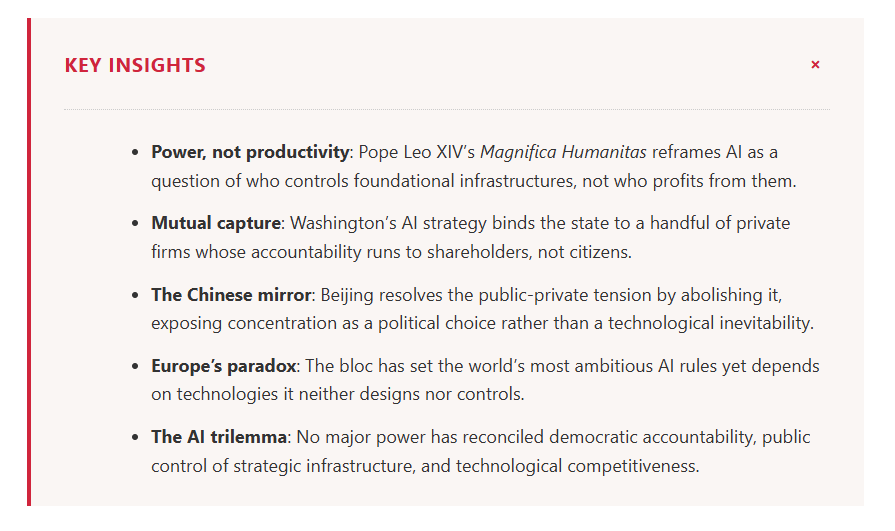
The dominant narrative about artificial intelligence concentrates on productivity, jobs, and competitiveness. These concerns are real. But they miss the deeper transformation underway. AI is not simply another productivity-enhancing technology. It is a foundational technology whose significance lies not only in what it produces, but in what it controls.
Advanced AI systems depend on extraordinarily concentrated inputs: hyperscale computing, vast proprietary datasets, specialised semiconductors, and frontier models. A small number of firms — overwhelmingly American, with a handful of Chinese counterparts — control all of these simultaneously. This
concentration is not incidental. It reflects the steep barriers to entry and powerful network effects that characterise the digital economy: the more data and compute you possess, the better your models; the better your models, the more users; the more users, the more data. The result is a
self-reinforcing logic of accumulation that makes competitive entry structurally improbable.
snip

 = new reply since forum marked as read
