Environment & Energy
Related: About this forum
Demand-Side Opportunities for Process Industry Participation in Electricity Markets
The paper I'll discuss in this post is this one: Demand-Side Opportunities for Process Industry Participation in Electricity Markets Iiro Harjunkoski and Santeri Vaara Industrial & Engineering Chemistry Research 2025 64 (51), 24675-24688.
The conception of this paper is one that's been on my mind, privately, for many years, which in my mind, I have labeled "The Kaiser Solution," based on something I heard some years ago, although I can no longer recall where I heard it, that Henry Kaiser would only run his Hall-Heroult aluminum plants when there was excess, and thus cheap, electricity on the grid in the Pacific Northwest, at that time, generally as a result of hydroelectricity production. On the other hand, when demand was high, the plants would be idled. I have no details of how this worked, and the business contracts behind the idea, or whether it was a wartime procedure, but again, the idea has stuck in my mind for many decades.
This is in opposition to the idea that energy storage is a good idea, an idea I often attack as thermodynamic and economic nonsense; it's environmental nonsense as well, since the need for redundancy - the default is actually dependent on dangerous fossil fuels despite all the hydrogen and battery bullshit that flies around - has economic and environmental consequences that are hardly benign. The belief that energy storage is a good idea is tied to the belief that the badly named "renewable energy" is sustainable, which it isn't, owing to its intense material and land demands, even before the pernicious need for redundancy is factored in.
I have never been shy around here from stating my opinion that nuclear energy is the only form of energy that I believe is acceptable. It is not risk free, but doesn't need to be vastly superior to all other options. A criticism of nuclear energy - which is only partially true - is that nuclear energy is not good at load following. Generally loads on the electric grid, almost everywhere in the world, peaks in the late afternoon and early evening hours. They are not flat.
Here for an example is a demand curve in my files on the CAISO (California) grid:
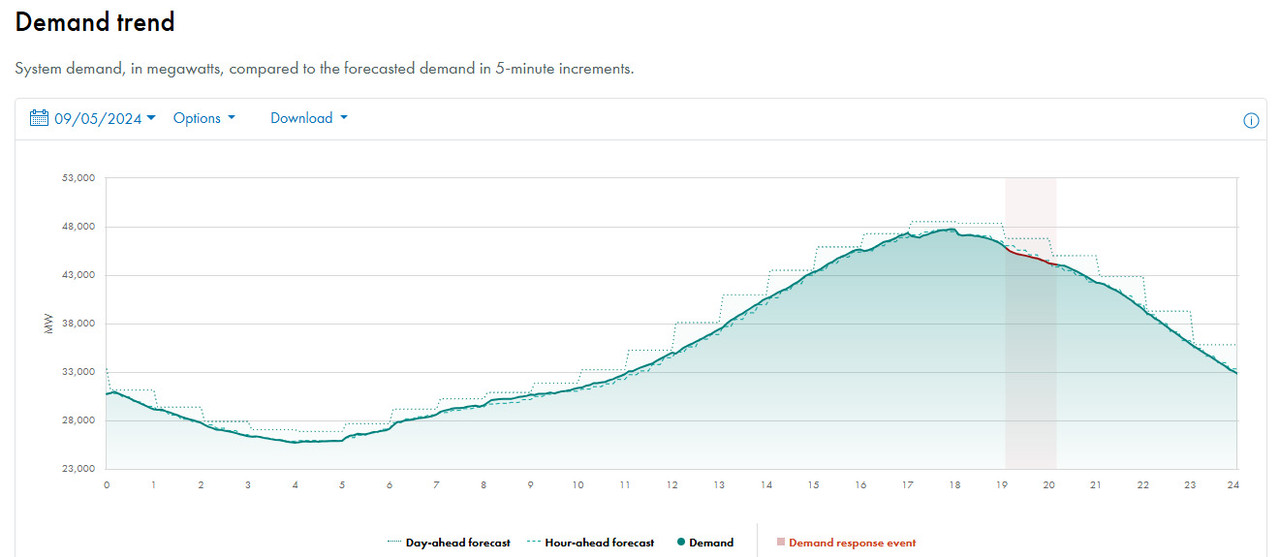
If one pokes around on the internet on almost any grid anywhere on any day of year, it is likely to look like this. Note that demand peaks when the sun is low in the sky or absent
Load following by nuclear plants involves - if one is feathering them down - on a simplistic level, inserting control rods to absorb neutrons. Because of reactor physics, particularly if a reactor is shut down completely, there is a lag time involved in powering up because of the decay of a radioactive isotope of iodine, 135I, into the radioactive isotope of xenon 135Xe, which has the highest neutron capture of all accessible nuclides, leading to "xenon poisoning" which - in the case of a total shutdown, can lead to a lag time for restart of several hours, until the 135Xe, (t1/2 = 9.1 hours) decays to 135Cs which has a moderate neutron capture cross section.
For these reasons it is generally believed that nuclear reactors run at or near full power, something they can, as the most reliable powerplants industrially available, do for years.
I have argued, here and elsewhere, that nuclear power plants should do far more than merely produce thermodynamically degraded electricity, via process intensification, that the high temperatures available from nuclear fuels should be utilized to increase exergy recovery. (Nuclear plants were originally conceived to replace coal plants in the first nuclear era, most coal plants at the time being low efficiency Rankine devices.)
For example, I offered a "pie-in-the-sky" idea of using nuclear heat for supercritical water desalination:
The Energy Required to Supply California's Water with Zero Discharge Supercritical Desalination.
With proper materials science systems, there is no reason that supercritical water resulting from the removal of ocean salts cannot produce, as a side product, electricity by turning a turbine, or alternatively, reform municipal waste (or sewage or industrial chemical waste) to yield carbon dioxide and hydrogen for fuel synthesis. If it happens that for industrial reasons - where for instance fresh water is the required product and electricity is not needed on the grid, that the power can be diverted to a plant utilizing electricity to reduce metal ores to the metal, as in the Hall-Heroult aluminum process or related processes such as the FFC process, or for that matter, a host of other applications in which electricity is used for production of commondities.
From the paper:
1. Controllable loads, where the grid operator can reduce/increase the load within specified limits. Examples of this are, e.g., large commercial building HVAC systems and some aluminum smelters in the United States (Alcoa), (3) as well as growing number of data centers.
2. Day-ahead bidding, where the industrial production process defines its production schedule based on an electricity price forecast and availability, trying to minimize its electricity cost while meeting the production targets. (5)
Both approaches have their merits and limitations. Controllable loads are fully managed by the network operator, and while, e.g., the ALCOA Warrick site reports enabling around 70 MW for this purpose, (3) the remuneration mechanism is still largely based on standard generator schemes. Thus, possible disruptions in production processes (the main business of the company) are not fully considered, and the magnitude of the regulation support is not reflected, i.e., the price per MW is the same for 10 MW as for 50 MW. However, operationally, these two situations can be significantly different. On the other hand, day-ahead bidding is purely based on price signals (or forecasts), and this is a relatively stiff approach that leaves little short-term flexibility for the production process. Unplanned disturbances in processes might disrupt the planned load schedule, resulting in heavy penalties that undermine the whole purpose of participating in demand response programs. Also, in many industrial environments, other base tariffs dominate, making DSM rather marginal, as the potential benefits are lower than the potential instabilities caused by price tracking. For instance, interrupting or delaying a smelting process step might result in temperature losses and the need for reprocessing, increasing the total energy need.
The topic of DSM first gained interest during the 1970s oil crisis, when rocketing energy prices created an urgent incentive for energy conservation and management. (6) Before the crisis, energy availability had been taken for granted, but suddenly, it became necessary to give high priority to the development of methods to better manage energy use. Although interest in DSM was reduced after the crisis, time-of-use and real-time pricing schemes were introduced to incentivize timing consumption for times of less congestion. The traditional consumption model was restored, and power and energy availability were again assumed to follow demand, and industrial processes were scheduled based on other constraining factors.
Process scheduling developed later with the increase in computational power from something done manually to finding mathematical optima, using computational models such as continuous-time approaches, (7) state-task network (8) (STN), and resource-task network (9) (RTN) models. The models are widely used for minimizing factors influencing process costs, such as makespan (10) and cycle time, (11) while considering the availability of other process variables, such as equipment, material, utilities, and personnel, and other resources when needed. Early DSM-adoption of the RTN model was done by Castro et al. (11−13) who expanded it to fit the needs of cement, steel, and the pulp and paper industry scheduling problems. DSM was again introduced as part of process scheduling when cost reductions for power-intensive processes realized their potential. Ierapetritou et al. (14) developed an MILP-based two-stage stochastic programming approach for minimizing the costs of an air separation plant based on electricity prices.
The potential for reducing electricity costs was recognized for many industrial processes, most notably air separation, (15−17) steel making industry, (13,18−20) electrolytic processes, (21,22) cement production, (23) and other heavy process industries...
...and so on...
The paper is rather long, and regrettably I will not have time to explore it here and now, but it makes a compelling case. Two figures offer cases for steel making, with the abbreviations described in the text:
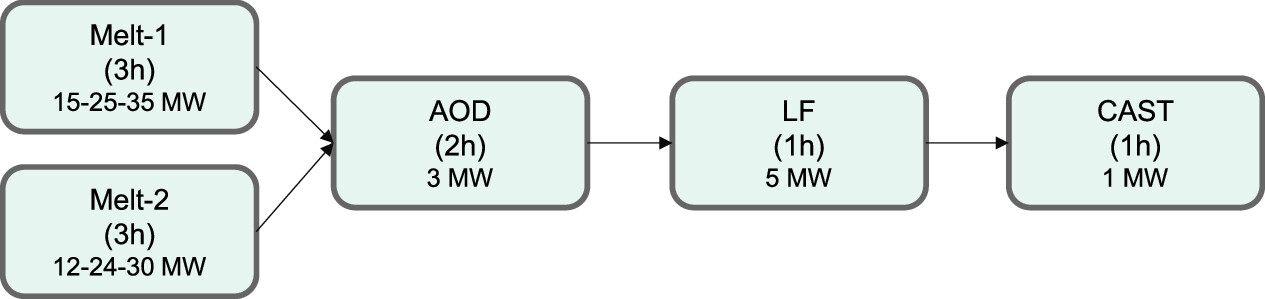
The caption:
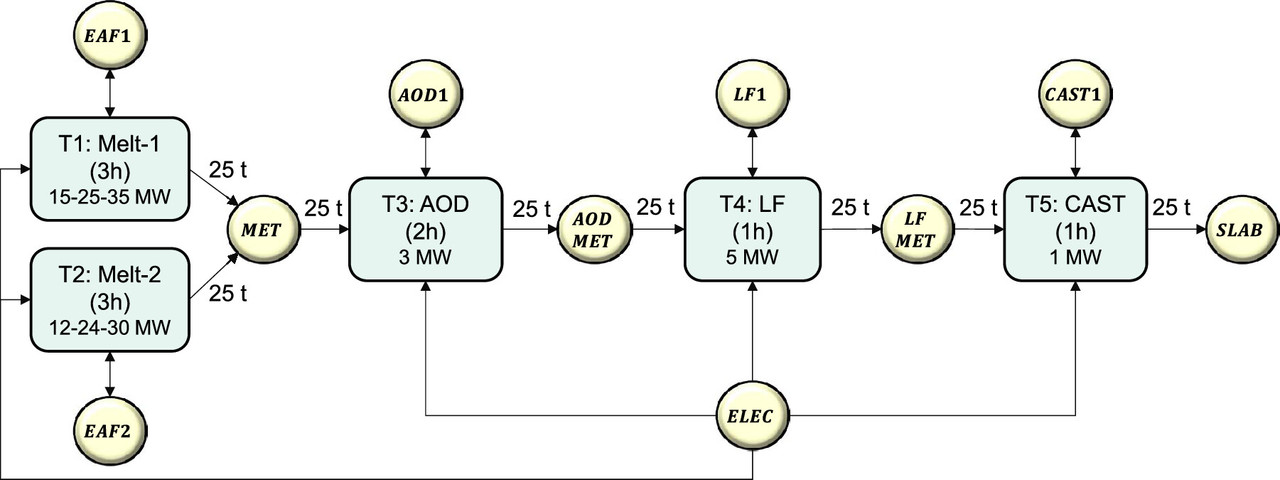
The caption:
The power grid always maintains - at least where the grid has driven by thermal powerplants - "spinning reserve" to address sudden changes in demand. It strikes me as a good idea to use this "extra" power for a useful purpose until demand calls on it. That is, on an admittedly simplistic level, the idea.
Have a nice day tomorrow.
 = new reply since forum marked as read
Highlight:
NoneDon't highlight anything
5 newestHighlight 5 most recent replies
= new reply since forum marked as read
Highlight:
NoneDon't highlight anything
5 newestHighlight 5 most recent replies