Environment & Energy
Related: About this forum
Is there enough copper on Earth for China's so called "Energy Transition?"
The paper I'll discuss in this post is this one: Binbin Li, Liang Wang, Ling Zhang, Huijun Wu, Zengwei Yuan, Navigating copper demand-supply dynamics for China's energy transition: Pathways to sustainable supply, Energy, Volume 330, 2025, 136913
Here at DU we hear a lot about so called "green" energy in China, the country with over 1000 coal powered electricity plants, a country that makes most of its industrial hydrogen by the steam reformation of coal, but also is the largest producer and user of solar cells and wind turbines.
It is also the largest by far builder of nuclear plants, and before this decade is out, will displace the United States as the largest producer of nuclear energy.
As far as energy goes, China is a case of "Everything all at once," just like the hyperkinetic movie with the same title.
Coal plants and nuclear plants are something that solar and wind plants are not, reliable. If one has solar and wind plants one must have redundant systems - there's lots of bullshit flying around about batteries and worse, hydrogen - but the reality is that solar and wind plants are backed up, in China, by coal. The use of hydrogen to back up solar and wind plants makes the use of coal worse, since the steam reformation of coal (using coal generated heat) since the laws of thermodynamics require that transforming coal into hydrogen destroys exergy, exergy being the term for recoverable usable energy. There is not in China, or for that matter anywhere else on Earth, enough excess so called "renewable energy" to justify industrial scale electrolytic hydrogen plants, nor is enough matter on Earth to justify mountains of batteries to back up so called "renewable energy."
So called "renewable energy" is not sustainable because of its enormous land demands, but more importantly, its material demands. It is the material demands that make the term "renewable" in the term, a joke, not a very funny one either.
The graphics in the paper cited indicate something about the unsustainable material demands of so called "renewable energy" and I'll produce a few.
First, from the introductory text of the paper:
As global warming intensifies, international efforts such as the Paris Agreement have called for collective action to limit temperature rise and promote low-carbon practices worldwide [1]. In this context, accelerating the energy system transition has emerged as a crucial strategy for countries to combat climate change and achieve sustainable development [2,3]. This transition encompasses not only the development of new energy sources, such as renewable energy like solar, wind, hydro, and nuclear power technologies, but also innovative methods of energy utilization, exemplified by electric vehicles, battery energy storage, and hydrogen energy technologies, etc. [4]. In this domain, copper is an indispensable raw material due to its excellent electrical and thermal conductivity. It is extensively utilized in vital energy transition equipment and technologies, including solar cells, wind power generation systems, and electric vehicles, playing a vital role in the energy transition.
The power and transport sectors, as pivotal components in the energy transition, will see an increasing demand for copper as core technologies for new energy sources mature and are gradually implemented [5,6]. However, this growing demand is met with the challenge of depleting copper reserves and intensifying pressure on copper supply [7]. The sustainable supply of copper is complex. On one hand, the extraction and processing of copper are constrained by geological conditions and environmental policies. On the other hand, advancements in recycling technologies can critically enhance the utilization and supply of secondary copper resources [8,9], profoundly affecting the copper metabolism pattern. Several studies have examined the effects of clean energy generation technologies and electric vehicle deployment on global copper metabolism [10,11]. For instance, Kalt et al. projected global metal demand from the power sector through 2050 [12], Habib et al. revealed critical metals supply risks associated with large-scale EV deployment [13], and Watari et al. simulated copper metabolism trajectories under carbon budget constraints [14]. These studies provide essential data to support a comprehensive analysis of copper metabolism in the low-carbon energy transition...
I like the word "metabolism" used in this context. Copper is, by the way, an essential element in living systems, many important enzymes require it, however it is one of those elements, like, say, selenium, that essential in some concentrations, toxic in excess.
Industrial metabolism is something quite different. Because of copper's excellent electrical conductivity, exceeded only by silver and gold, its rarer congeners, it plays an important role in all industrial systems involving electricity, notably in generators and transmission lines.
Now about a term often thrown around these days which is in my view, a nonsense term: "Energy transition." It appears nine times in just this short amount of text. There is no "energy transition." We are using more fossil fuels than ever before and the use is rising not falling. This paper delineates the limits.
Further on in the text, not much further, the source of the largest concern is identified:
I added the bold.
All of the bolded words are popular among our "renewable energy will save us" types, who, by the way, have little or no concern about fossil fuels. They call the bolded terms "green." (Well if one must know, copper salts, oxides and sulfides in the most common oxidation state, 2+, are green, but that's about where it ends.) Why mention only these cases? Because they function only for small portions of any given day. Wind power, solar power, and the use of vehicles are intermittent, for the majority of the time all of the copper in them is stranded copper, doing nothing useful for humanity. This is also true of the wires connecting the redundant systems, which despite all the battery and hydrogen bullshit that flies around, are in China, as is the case everywhere else on the planet, fossil fuel systems. Moreover, if a coal plant is shut for a few hours because the wind is blowing and the sun is shining, the copper contained in that plant is stranded copper.
The paper identifies four sources of what they - not I - call "clean" energy: Solar, Wind, Hydro and Nuclear. Only one of these forms is both reliable and infinitely expandable. Only one exhibits the energy density to minimize disruption to the natural world. That's nuclear. It's nice to see, in the literature the recognition, which should have always been obvious, but often ignored for reasons that can only be social, not at all connected with reality, that nuclear is a clean form of energy; it is in fact the cleanest of all.
There is a lot of discussion in this rather long paper of copper flows, including some relying on the time to obsolescence with an assumption that systems that have failed will be recycled, a somewhat dubious assumption in my view. Wind and solar junk has short lifetimes before requiring replacement, but the distribution of the junk is by its very nature diffuse. It takes energy and careful attention to collect it, transport it, dismantle it, isolate the components. The more mass that is involved, the more diffuse the distribution of materials the more energetically intense the recycling requirements, and...this is important, the percentage - which will never be 100% recovered.
Let me get personal, and discuss my own moral failings:
One can recognize this oneself if one is, as I am, sufficiently bourgeois and is in possession of small devices containing copper, and can, in fact extend this to other elements. I have two electric chainsaws, for example, one that was corded and run by copper containing extension cords, and one that is battery powered - the brand being an Ego chainsaw which uses cobalt/nickel/manganese type lithium ion batteries. One of the five Ego batteries I have, one for the chainsaw, two for the snow blower, one for the lawn mower, there is one that failed and was replaced under warranty. When I called for the warranty the nice woman there told me to bring the failed battery back to the store. I mean to do it, I really do, but well, I keep not getting around to it. I have no idea where I might take the corded chainsaw to recycle it to recover the copper in it. So it sits, with its sequestered copper in my garage, useless to serve humanity, unless I find the time and the energy involved in driving my car to some place where further energy might be spent to dismantle it and sort through whatever valuable materials it may contain, and discard those that are not worth recovering.
My Ego batteries contain conflict metals, mined by slaves or near slaves in Africa, and I know all about that, but am morally insufficient to do something about it, that is, drive my hybrid car with its conflict metal batteries back to the store to recycle the battery.
I'm sure I'm not alone in this bourgeois behavior.
Let's return to the paper, a nice paper, and China and copper.
The paper offers graphics demonstrating how copper is distributed among uses, and it informs, in my view everything one needs to know about how copper is utilized in China.
The first, a (simpler) KEGG type schematic of "copper metabolism" in China:
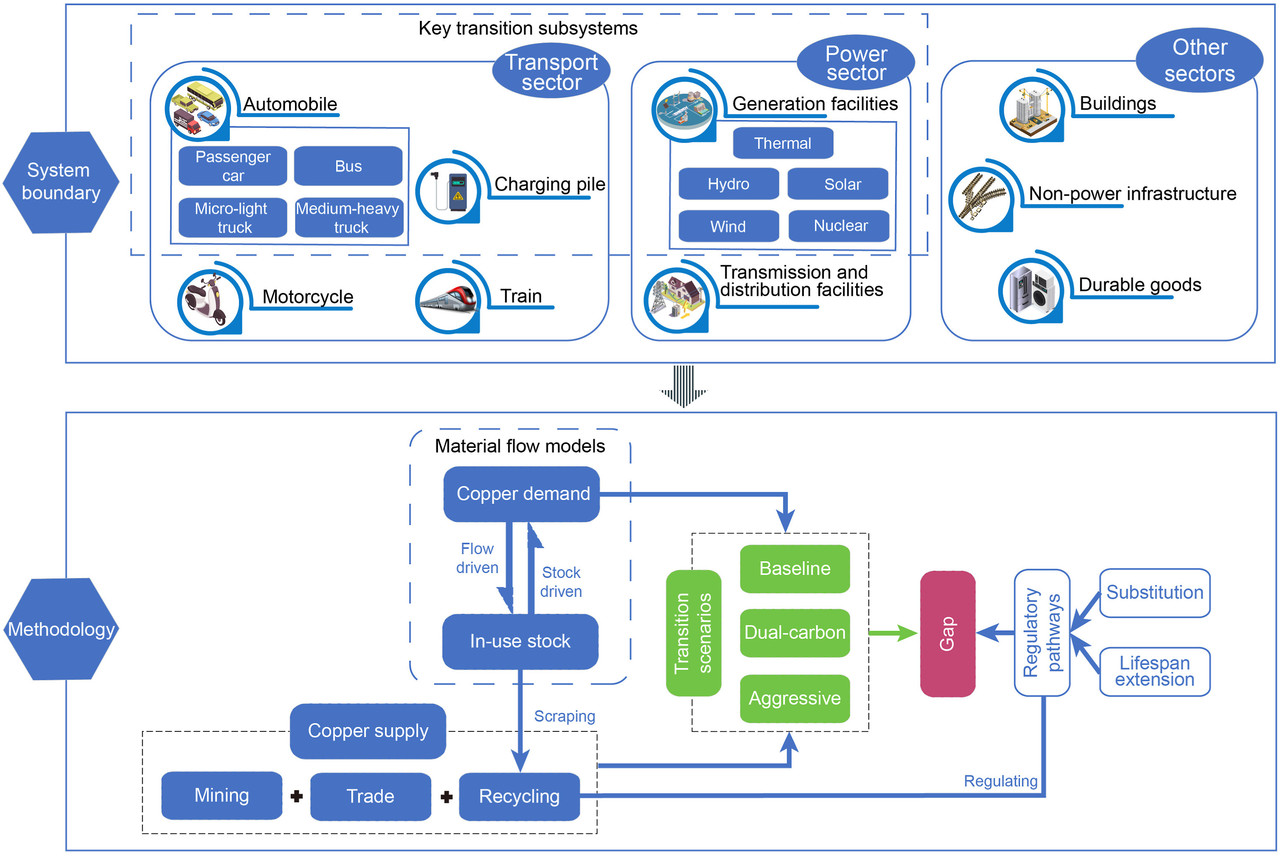
The caption:
Note: Key subsystems refer specifically to those involved in the energy transition. In the transport sector, they include conventional vehicles, new energy vehicles, and charging piles, excluding trains and motorcycles. In the power sector, they include thermal, hydro, wind, solar, and nuclear power generation facilities, but exclude transmission and distribution infrastructure.
Note the transmission exclusion.
The second, most critical is the apportioning of copper to the various systems it supports:
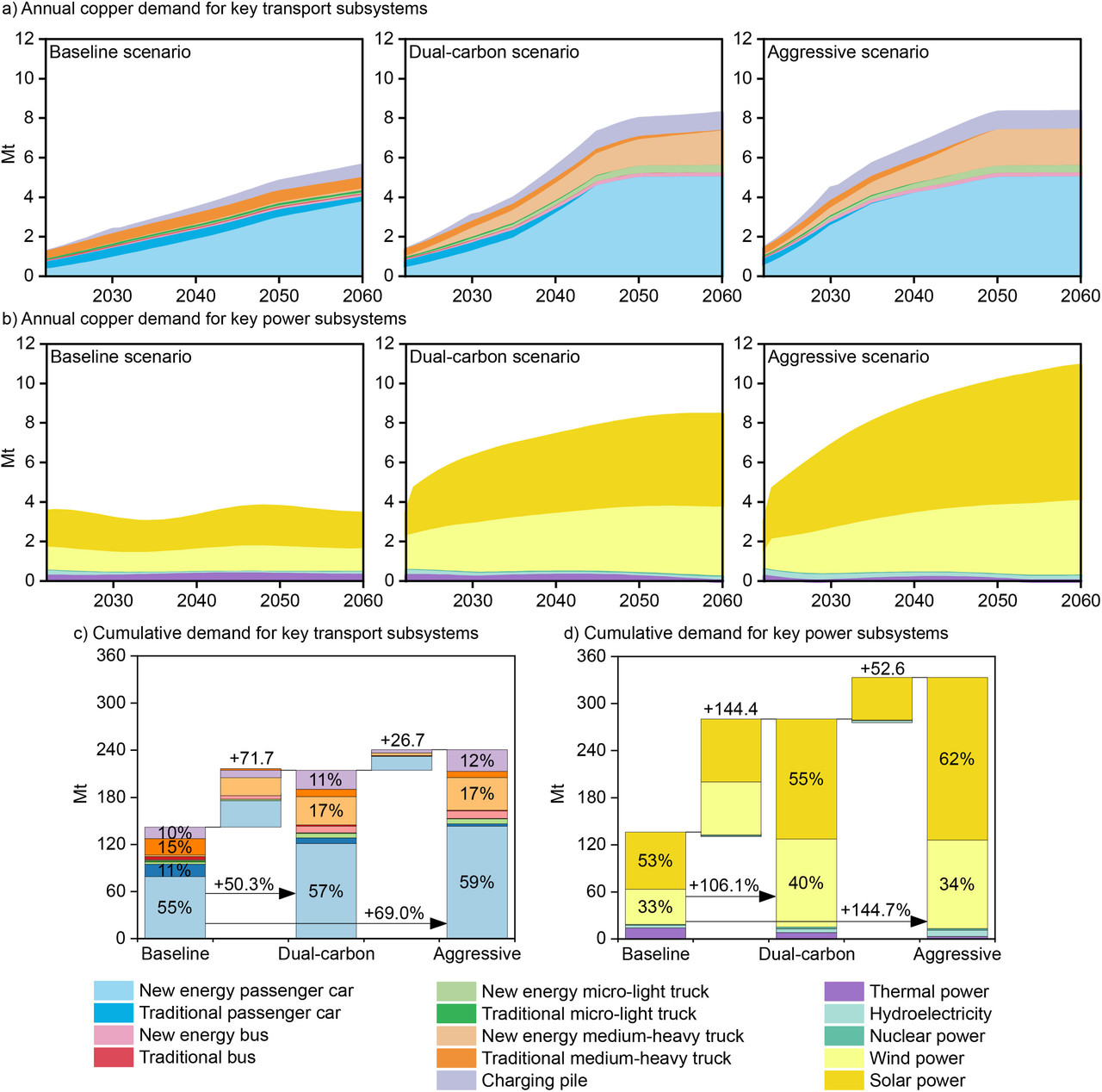
The caption:
Note: Subfigures a and b represent the annual copper scrap from key subsystems in transport and power sectors, respectively, under three transition scenarios. Subfigures c and d represent the cumulative copper scrap from key subsystems in transport and power sectors, respectively, under the three transition scenarios.
It behooves me to define the "three scenarios," scenarios being an element of soothsaying that all of our antinukes and "I'm not an antinuke" types love to wax romantic about with all their "by 2040," "by 2050" and so on wishful thinking.
From the text of the paper, the baseline scenario:
...and...
...and...
In each excerpt I have added the bold.
Note than it none of the "scenarios" does nuclear energy appear as a major driver of copper demand, not because China does not have, and will not have nuclear plants, but rather because the nuclear plants, unlike the solar and wind junk, are mass efficient. One does not need a vast array of wires to connect systems that operate less than 30% - in the case of solar way less than 30% of the time, and at the same time, connect them to redundant systems. For 70% of the time, all of the copper is as useless as the copper in my disused corded chainsaw about which do not know I might have the copper recovered. Nuclear plants are mass efficient, solar and wind facilities are not mass efficient.
As I frequently point out, the Diablo Canyon nuclear plant in California produces, routinely, on a foot print of less than 12 acres, with only a few transmission lines connecting it to California's major grids, almost as much energy as all the wind turbines in that benighted State spread over hundreds, perhaps thousands of square miles, lacing connecting wires all over the State, with - when the wind isn't blowing - as useless as the copper in the abandoned chain saw in my garage.
In 2024, all the wind turbines in the State of California produced 15,781 GWh (56.7 Petajoules) of electricity, the two reactors at the single nuclear plant in California at Diablo Canyon, 18,379 GWh, (66.2 Petajoules).
Now, I have recently been referring to the book I am not finding as much time to read as I might like to do, a book written by an investigative journalist:
The Elements of Power
Subtitle:
The parts I have read refer to the (literally) green ore of copper found in the Katanga area of central Africa where appalling conditions exist for the people who have to mine that ore, along with the Coltan (niobium and tantalum) and cobalt ores found in the region.
Copper is a conflict metal. There is a moral cost of copper quite independent of its environmental and economic cost and the cost of its depletion for future generations, itself another facet of the moral cost.
Oxidized copper, which in general cannot be recovered by recycling is "green" in the literal sense of the word. The use of copper to engage fantasies about so called "renewable energy" - the metaphoric sense - is hardly "green," It is, in fact, an obscene injustice, not even to the slaves or near slaves who mine it in Africa, and even the well paid miners elsewhere, but to all future generations.
Wind power and solar power have done nothing, zero, zilch, zip to eliminate the use of fossil fuels, which continues to increase, destroying the planetary atmosphere.
This last statement calls into question what the authors define as "clean energy" in this excerpt from their conclusion to their paper:
The application of clean energy technologies is poised to dramatically reshape the overall copper metabolism in China. The combined share of the transport and power sectors in total copper demand is expected to rise from the current 61.9 % to 67.3 %−77.5 % varied across the three scenarios, underscoring their role as the primary drivers of copper demand during the energy transition.
"Clean" for whom?
I would suggest that the case presented in this paper, were one to really seriously reflect upon it, indicates that these sources of energy, short lived, mass and wilderness intensive objects of so much wishful thinking, never will, because they never can. There is not enough metal on the planet to make it so, and the moral, environmental and economic cost of metal suggests that material efficiency is a critical path for critical materials, much discussed in the literature outside of the mainstream handwaving and wishful thinking.
Nuclear energy is not risk free, nor will it ever be. It doesn't need to be risk free to be lower risk than everything else; it only needs to be lower risk. Nuclear energy is not without environmental impact. It does not need to be without environmental impact to have lower environmental impact than everything else. Nuclear energy is not devoid of material demands, but it doesn't need to be devoid of material demands to be vastly superior to everything else in this regard.
Neither its risks nor its environmental impact should be held as a special case devoid of comparison to all other options. We are well beyond the "crossroads" that may have existed with respect to our energy choices, but it may be time, albeit definitely too late, to reverse course to go back to the fork in the road and choose the wiser, safer, and cleaner pathway we did not choose before.
I hope your Memorial Day weekend was an enjoyable one.