American History
Related: About this forumOn February 12, 1946, returning veteran Isaac Woodard was beaten until blind by SC police chief Lynwood Shull.
Hat tip for the skeet, Larry Glickman. or maybe Kevin Kruse, who I think reposted it.
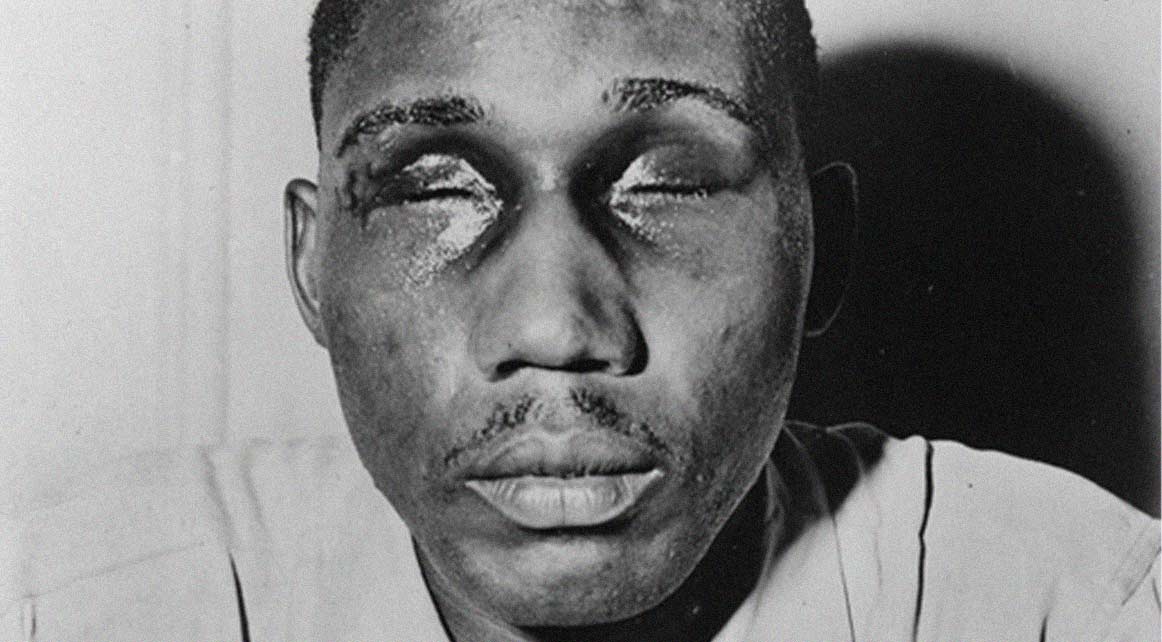
Police Chief in South Carolina Beats Black Veteran Isaac Woodard, Leaving Him Blind
Detroit Tribune
On February 12, 1946, Sgt. Isaac Woodard, a Black World War II veteran, boarded a Greyhound bus in Georgia heading home to his wife in North Carolina. He had been honorably discharged from service just hours earlier. ... When the bus stopped outside of Augusta, South Carolina, Sgt. Woodard, who was still in uniform, asked the driver if there was time to use the restroom. The driver cursed at him and resumed driving. “Talk to me like I am talking to you,” Sgt. Woodard told him in response, adding: “I am a man just like you.”
After a brief argument, Sgt. Woodard returned to his seat. At the next stop in Batesburg, South Carolina, the bus driver exited and called Lynwood Shull, the local police chief, who arrived soon after. Officer Shull removed Sgt. Woodard from the bus and began brutally beating him with a blackjack. Sgt. Woodard, who was unconscious and badly injured, was then left in the Batesburg jail overnight. The next morning the city court fined him for disorderly conduct.
When Sgt. Woodard was finally transferred to a VA hospital in Columbia, South Carolina, doctors determined that the beating and delay in medical treatment had permanently blinded him.
In October 1946, President Harry S. Truman ordered his attorney general to bring federal charges against Chief Shull. The trial began a month later and was presided over by Judge J. Waties Waring, whose father was a Confederate soldier. After deliberating for less than 20 minutes, the all-white jury acquitted Officer Shull.
{snip}
Listen To Orson Welles Denounce Police Brutality Against Black WWII Veteran
PUBLISHED
AUG 26, 2020 AT 12:11 PM EDT
By Andrew Whalen
Writer
When police beat and blinded a Black man, the National Association for the Advancement of Colored People turned to Citizen Kane director and famous radio broadcaster Orson Welles to tell his story. ... In World War II Isaac Woodard served as a longshoreman, unloading ships in the Pacific theater while under fire. After his honorable discharge from the military on February 12, 1946, Woodard set out to meet his wife, catching a Greyhound bus from Georgia to South Carolina, where the 26-year-old Black man grew up under segregation and Jim Crow. But just a few hours after his discharge, while still wearing his uniform, police forced Woodard from the bus in the town of Batesburg (now Batesburg-Leesville), South Carolina.
Several officers, including the town's police chief Lynwood Shull, took Woodard to an alleyway, where they beat him with nightsticks. Then they arrested him for disorderly conduct, jailed him, then beat him throughout the night, jabbing him in the eyes so many times with their billy clubs that the globes were irreparably damaged. ... The next morning, Woodard was brought before a local judge and fined fifty dollars. He wouldn't receive medical assistance for a further two days. Suffering from temporary amnesia after the attack, Woodard wasn't found by his family for three weeks. The assault left him permanently blind.
While the NAACP brought the story to liberal newspapers and the Black press, the organization's Executive Secretary Walter White and cartoonist Ollie Harrington—recently tasked with building out the NAACP's public relations—wanted to make Woodard's assault by police national news. In July, 1946, White sent a letter to famous radio broadcaster and movie director Orson Welles, which included an affidavit written by Woodard.
Welles had produced multiple radio programs throughout the 1940s, from variety shows to news programs meant to bolster Allied war efforts. In September 1945, ABC began broadcasting "Orson Welles Commentaries," a series of 15-minute political and social commentaries that covered everything from atomic bomb testing to Louis Armstrong. Welles found in Woodard the most powerful story the program would ever tell. ... On his July 28, 1946 episode , Welles opened by reading Woodard's account of his assault in full. With the boost from a national platform and one of the most famous voices in recorded history, Woodard's assault became a national flashpoint. ... Welles aired four further episodes about Woodard. Here is the first:
{snip}
@larryglickman.bsky.social
When Tom Homan, Trump and other Republicans defend the masking of ICE agents, I can't help but think of Orson Welles announcing on his radio show his intention of identifying the South Carolina police officer who violently attacked and blinded the uniformed Black veteran Isaac Woodard in 1946.
Naming the policeman Officer X, Welles addressed him directly. "Wash your hands, Officer X. Wash them well. Scrub and scour, you won't blot out the blood of a blinded war veteran," Welles said. "Go on, suckle your anonymous moment while it lasts. You're going to be uncovered. We will blast out your name! We'll give the world your given name, Officer X. Yes, and your so-called Christian name. It's going to rise out of the filthy deep like the dead thing it is."
ALT
2:33 PM · Feb 19, 2026
When Tom Homan, Trump and other Republicans defend the masking of ICE agents, I can't help but think of Orson Welles announcing on his radio show his intention of identifying the South Carolina police officer who violently attacked and blinded the uniformed Black veteran Isaac Woodard in 1946.
— Larry Glickman (@larryglickman.bsky.social) 2026-02-19T19:33:15.230Z
@larryglickman.bsky.social
I recommend the excellent American Experience documentary, "THE BINDING OF ISAAC WOODWARD," which includes audio of Welles' broadcast. See also this Newsweek article by Andrew Whalen.
https://www.newsweek.com/listen-orson-welles-isaac-woodard-police-brutality-radio-1527586
https://www.newsweek.com/listen-orson-welles-isaac-woodard-police-brutality-radio-1527586
www.newsweek.com
2:35 PM · Feb 19, 2026
I recommend the excellent American Experience documentary, "THE BINDING OF ISAAC WOODWARD," which includes audio of Welles' broadcast. See also this Newsweek article by Andrew Whalen.
— Larry Glickman (@larryglickman.bsky.social) 2026-02-19T19:35:49.625Z
www.newsweek.com/listen-orson...
@riecks.bsky.social
The folks at Radio Diaries
@radiodiaries.bsky.social
just focused on this topic recently. "Orson Welles and the Blind Soldier" available wherever fine podcasts are found, https://www.radiodiaries.org/post/orson-welles-and-the-blind-soldier.
Orson Welles and the Blind Soldier
In 1946, radio host Orson Welles heard of a shocking crime and pledged to solve it... on the air. Three-part series.
www.radiodiaries.org
4:44 PM · Feb 19, 2026
The folks at Radio Diaries @radiodiaries.bsky.social just focused on this topic recently. "Orson Welles and the Blind Soldier" available wherever fine podcasts are found, www.radiodiaries.org/post/orson-w...
— David Riecks (@riecks.bsky.social) 2026-02-19T21:44:40.660Z
Reposted by Larry Glickman
https://bsky.app/profile/larryglickman.bsky.social
@brandonbird.bsky.social
Follow
Ditto this recommendation, it's on youtube:
The Blinding of Isaac Woodard | Full Documentary | AMERICAN EXPERIENCE | PBS
YouTube video by American Experience | PBS
youtu.be
Larry Glickman
@larryglickman.bsky.social
· 3h
I recommend the excellent American Experience documentary, "THE BINDING OF ISAAC WOODWARD," which includes audio of Welles' broadcast. See also this Newsweek article by Andrew Whalen.
www.newsweek.com/listen-orson...
https://www.newsweek.com/listen-orson-welles-isaac-woodard-police-brutality-radio-1527586
www.newsweek.com
2:38 PM · Feb 19, 2026
Ditto this recommendation, it's on youtube: youtu.be/80GKeyIqDW0?...
— Brandon Bird (@brandonbird.bsky.social) 2026-02-19T19:38:21.649Z
Thu Feb 12, 2026: This is why Black History Month is needed
 = new reply since forum marked as read
Highlight:
NoneDon't highlight anything
5 newestHighlight 5 most recent replies
= new reply since forum marked as read
Highlight:
NoneDon't highlight anything
5 newestHighlight 5 most recent replies

spike jones
(2,006 posts)JT45242
(3,956 posts)So depressing. And 1/3 of our country today would still acquir.