An ancient solar storm left clues in tree rings and a famous poet's diary: 'Red lights in the northern sky'
By Keith Cooper published 6 hours ago
Medieval records of the northern lights extending as far as Japan have led researchers to evidence for a powerful burst of protons from the sun.
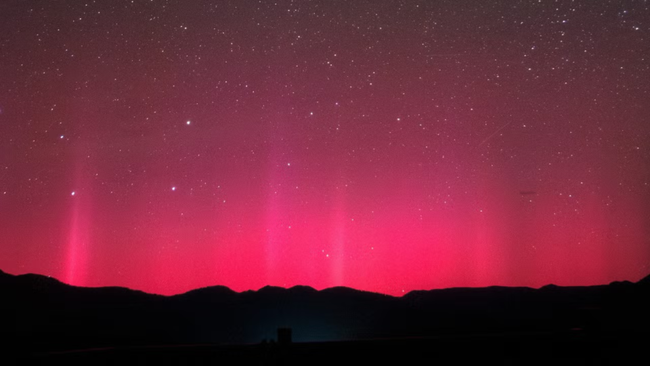
The silhouette of what looks like mountains on the bottom of the screen with bright pink and red lights in the sky above. A red aurora like the one seen over Japan in 1204. (Image credit: Tomohiro M. Nakayama (CC-BY-NC).)
The solar cycle was several years shorter and the sun was experiencing an unusually active phase at the beginning of the 13th century — at least, that's the story told by evidence left behind in tree rings and historical records that suggest a burst of protons and enhanced coronal mass ejections battered Earth between the years 1200 and 1204 CE.
More specifically, scientists led by Hiroko Miyahara of the Okinawa Institute of Science and Technology (OIST) Solar–Terrestrial Environment and Climate Unit in Japan have found remnants of a dramatic solar proton event in tree rings dating back 825 years.
A solar proton event, or SPE, is a barrage of protons that are accelerated to nine-tenths the speed of light by solar flares and coronal mass ejections. SPEs can be extremely dangerous, threatening astronauts and spacecraft. While Earth's magnetic field can keep out most of the protons, occasionally some burst through Earth's magnetic shield and descend into the atmosphere where they collide with atmospheric gases, creating atoms of a kind of carbon (carbon-14) that drift around the planet and become incorporated into living organisms — including trees.
Miyahara's team used "Meigetsuki," which is the diary of a Japanese courtier and poet named Fujiwara no Teika who lived between 1162 and 1241, as a starting point in their search for historic SPEs. The diary said that, in February of 1204, the poet saw "red lights in the northern sky over Kyoto." Kyoto is located at 35 degrees north, which is a rather low latitude to be witnessing an aurora since auroral lights are usually confined to the poles — the stronger the solar storm, the closer to the mid-latitudes the lights are seen. (It must have been especially strange to Fujiwara no Teika, who would not have known what he was looking at.)
More:
https://www.space.com/stargazing/auroras/an-ancient-solar-storm-left-clues-in-tree-rings-and-a-famous-poets-diary-red-lights-in-the-northern-sky
