Welcome to DU!
The truly grassroots left-of-center political community where regular people, not algorithms, drive the discussions and set the standards.
Join the community:
Create a free account
Support DU (and get rid of ads!):
Become a Star Member
Latest Breaking News
Editorials & Other Articles
General Discussion
The DU Lounge
All Forums
Issue Forums
Culture Forums
Alliance Forums
Region Forums
Support Forums
Help & Search
Science
Related: About this forum
One of Neptune's 16 moons is not like the others, James Webb telescope finds -- and it could be key to fully understandin
One of Neptune's 16 moons is not like the others, James Webb telescope finds — and it could be key to fully understanding the solar systemNeptune has a complicated life story, and its moon Nereid might be the only one left standing from the planet’s multibillion-year history.
By Elizabeth Howell
published 12 hours ago
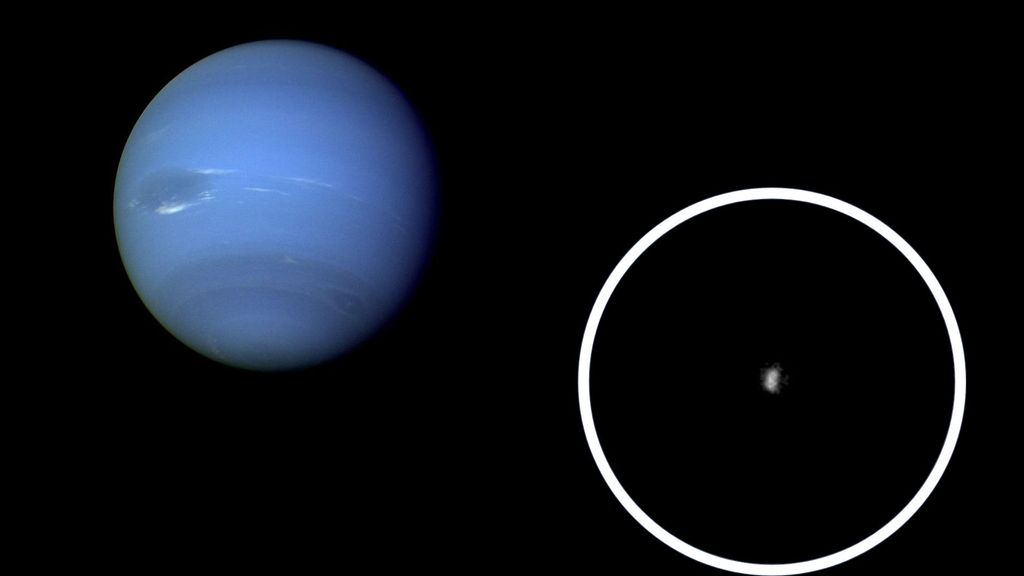
Nereid (inset) may be the only moon of Neptune (background) that was around when the planet first formed, a new JWST study hints. (This composite image is not to scale).
(Image credit: NASA/JPL)
One of Neptune's largest moons has stuck around the neighborhood much longer than scientists previously thought — in fact, it may be the sole survivor of the planet's earliest days.
Nereid, Neptune's third-largest moon, is probably the only moon left over from when the ice giant formed early in the solar system's 4.5 billion-year history, a new analysis of James Webb Space Telescope (JWST) data suggests.
The results, published Wednesday (May 20) in the journal Science Advances, contradict the previous story about Nereid's history told in the decades since its 1949 discovery: that Neptune "captured" the 220-mile-wide (350 kilometers ) moon from an icy well of bodies in the outer solar system known as the Kuiper Belt.
JWST's observations were key to this realization, said first study author Matthew Belyakov, a graduate student in planetary science at Caltech. "What JWST did for Nereid is it confirmed that it had a lot of water ice, and gave us the overall shape of the spectrum [of light]," Belyakov told Live Science in a phone call.
More:
https://www.livescience.com/space/neptune/one-of-neptunes-16-moons-is-not-like-the-others-james-webb-telescope-finds-and-it-could-be-key-to-fully-understanding-the-solar-system
4 replies
 = new reply since forum marked as read
Highlight:
NoneDon't highlight anything
5 newestHighlight 5 most recent replies
= new reply since forum marked as read
Highlight:
NoneDon't highlight anything
5 newestHighlight 5 most recent replies
= new reply since forum marked as read
Highlight:
NoneDon't highlight anything
5 newestHighlight 5 most recent replies
One of Neptune's 16 moons is not like the others, James Webb telescope finds -- and it could be key to fully understandin (Original Post)
Judi Lynn
May 22
OP

Jerry2144
(3,417 posts)1. That's no moon. It's a space station.
Pops into my mind for some reason.
Fun movie

duckworth969
(1,476 posts)2. I like science
It’s neat.
If I ever marry again, I want my partner to be the Hubble Telescope.
But I must love her from afar… 😢

hatrack
(65,416 posts)3. I'm not sure if you've seen "The Farthest", which is Nova's story about the Voyager missions . . .
If you haven't, it's a wonderful episode, and one of the most engaging and positive stories I've seen in my life. Science!!
https://www.pbs.org/the-farthest/

lastlib
(28,925 posts)4. Well worth watching!
Thanks! 